
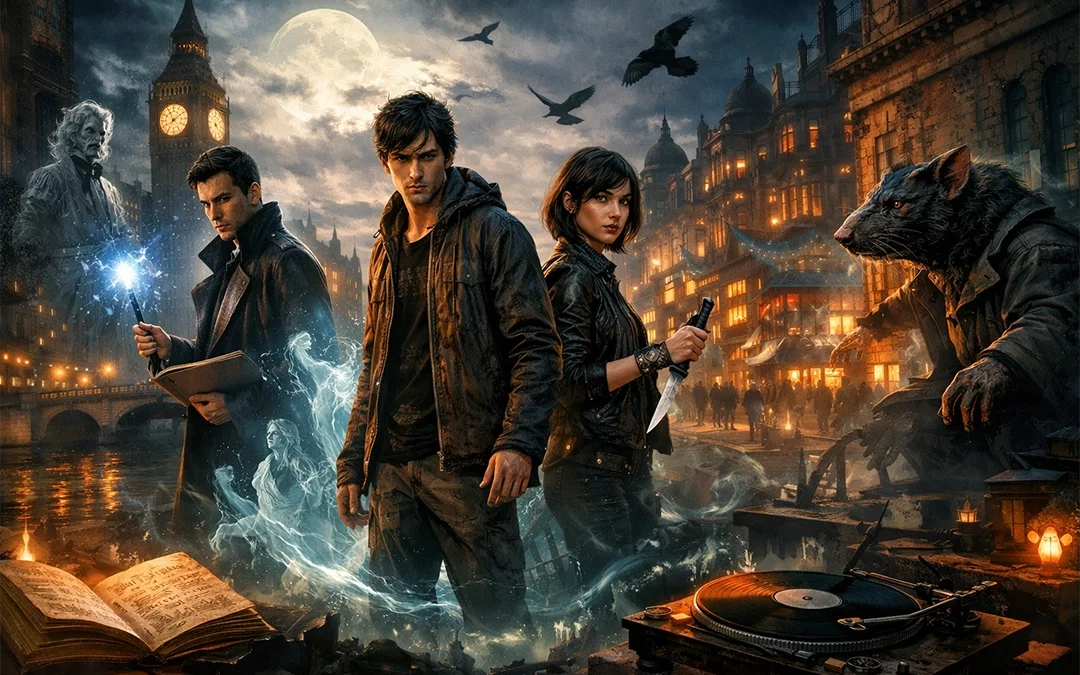
Urban fantasy gets mislabeled a lot. If you browse certain corners of TikTok or Amazon, you’d think the genre is just leather jackets, brooding vampires, and a love triangle on every other page. That’s partly a market distortion.
Paranormal romance and romantasy had a massive run in the 2000s and 2010s, so bookstores grouped everything supernatural under the same banner. The result is a skewed perception: readers who aren’t into romance assume the entire genre is off-limits.
That assumption doesn’t hold up once you look at the broader history.
What Urban Fantasy Really Is
Urban fantasy is older than the romantasy wave, and it’s rooted in something different: mythology colliding with modern life, hidden cities under the surface of real ones, noir-style investigations, alternate bureaucracies, and magic systems embedded in the mundane.
- Gaiman’s Neverwhere predates modern paranormal romance by nearly a decade.
- Charles de Lint was writing about mythic cities and folklore before most readers had ever heard the term “romantasy.”
- Even Jim Butcher’s Dresden Files, which launched at the height of vampire boom, wasn’t structured around courtship arcs.
The interesting question is why the genre keeps getting flattened into a single trope.
A skeptic might argue it’s algorithmic convenience. Platforms sort books by what sells, and romantasy currently sells. Publishers feed the loop, bookstores follow the metadata, and suddenly an entire genre appears narrower than it really is.
Another angle is cultural: audiences often conflate “urban fantasy” with “paranormal romance” because both involve supernatural beings in real-world settings.
The difference is simple once stated: in urban fantasy, the core conflict isn’t romance, and the narrative spine isn’t relationship-driven. The stakes are usually civic, mythic, criminal, or metaphysical rather than romantic.
Below is a selection of urban fantasy that foregrounds magic systems, worldbuilding, and mystery instead of love triangles.
These books are useful not only as recommendations but as evidence that the genre contains a wider ecosystem of storytelling.
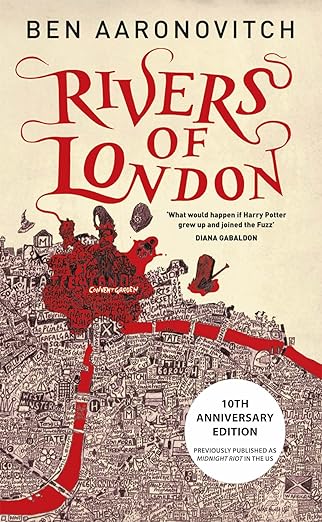
Rivers of London — Ben Aaronovitch (2011– )
Synopsis: Peter Grant, a mixed-race Metropolitan Police constable, discovers that magic exists after interviewing a ghost at a crime scene. He becomes the apprentice of the last officially recognized wizard in Britain and gets pulled into a world of magical policing, river spirits, jazz vampires, and bureaucratic headaches.
The setting toggles between tourist London and a folkloric London that readers who know the city will recognize under the surface.
Why it matters: The focus here is procedural storytelling. Casework, magical forensics, historical ghosts, and territorial river deities drive the plot. Romance is marginal at best. The real draw is how Aaronovitch treats London as a character with its own politics and memory.
Readers who like mystery, urban planning, or folklore tend to latch onto this series. It’s also a counterweight to the assumption that urban fantasy requires a chosen-one arc; Peter’s growth is incremental, professional, and occasionally petty, which feels more grounded than the genre stereotype.
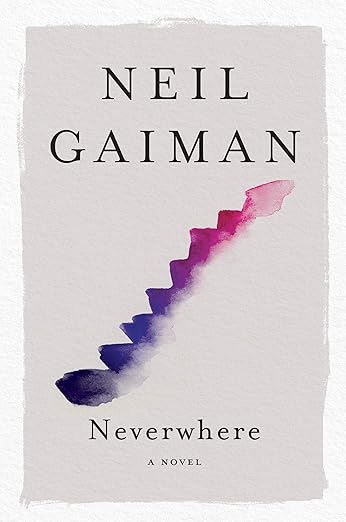
Neverwhere — Neil Gaiman (1996)
Synopsis: Richard Mayhew is a bland office worker living an unremarkable life until he stops to help a wounded girl named Door on a London sidewalk. Overnight, Richard becomes invisible to the normal world and falls into London Below, a subterranean realm of markets under Harrods, assassins named after the Angel Islington, and forgotten people and places that have taken on literal form.
Why it matters: Gaiman is not writing about romance here. He’s writing about invisibility, class systems, and the strangeness of cities. Urban fantasy draws a lot of its literary DNA from this novel: the hidden geography, the mythic bureaucracy, the idea that cities generate their own folklore.
Readers who aren’t into romance but love cities, maps, and liminal spaces often start here. In conversations about genre evolution, Neverwhere is frequently cited as foundational (see Ekman, Urban Fantasy: Literary Cityscapes and Contemporary Culture, 2018).
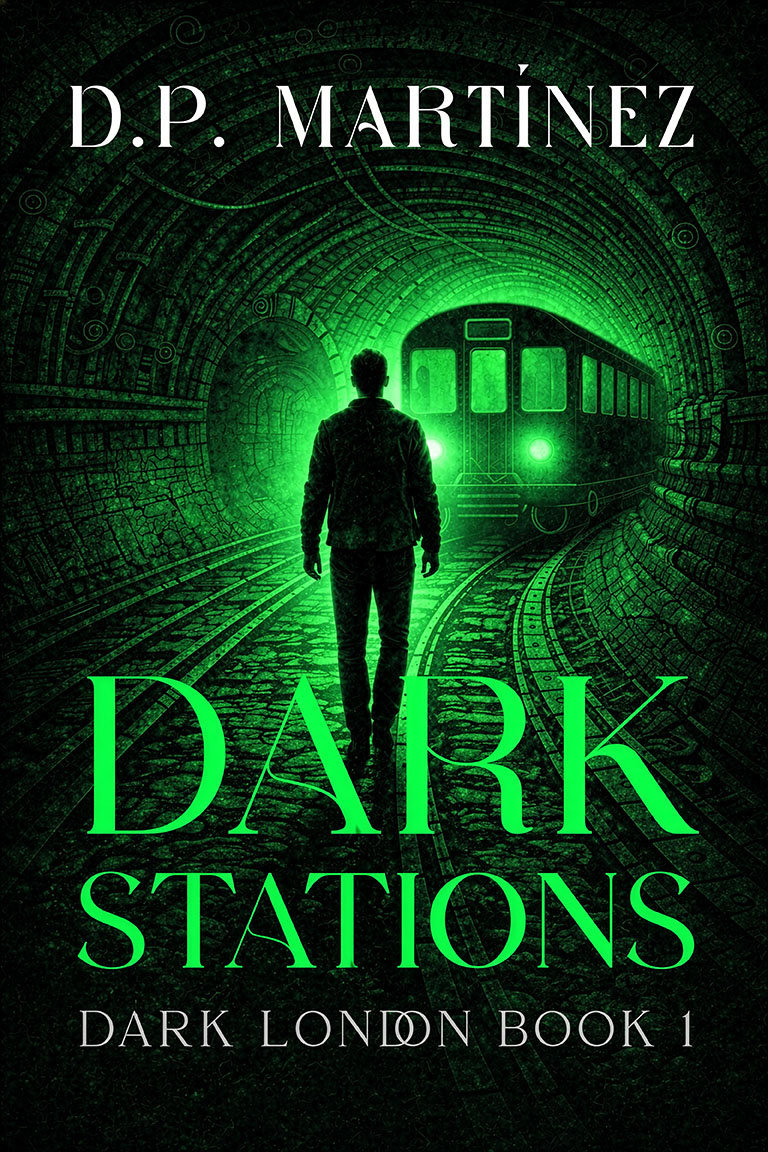
Dark Stations: An Urban Fantasy Novel
Ghosts ride the London Underground, boarding at stations that don’t exist. One day, a man steps off with them to search for his dead daughter.
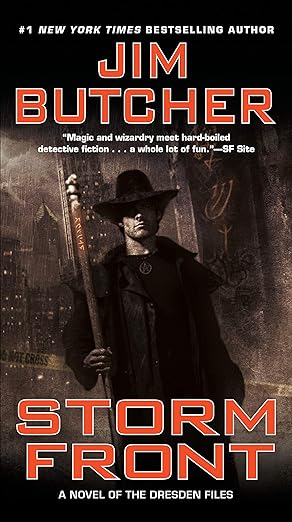
The Dresden Files — Jim Butcher (2000– )
Synopsis: Harry Dresden is a professional wizard-for-hire in Chicago, working out of a dingy office and dealing with petty clients, supernatural courts, mafiosi, and the city’s magical ecosystem. Cases escalate from missing persons to apocalyptic conspiracies over the course of the series, but the detective structure remains the backbone. The voice is noir with a wry edge.
Why it matters: Dresden isn’t designed for a romantasy market. The plot is investigative, the stakes are civic, and the emotional arcs revolve around loyalty, trauma, and power rather than dating. The series also demonstrates how urban fantasy can sustain long-form storytelling without relying on a central romance.
Genre critics have argued that a lot of serialized UF either imitates or reacts to Dresden’s pacing and faction complexity. Readers who like crime fiction, conspiracies, and rule-based magic usually end up here.
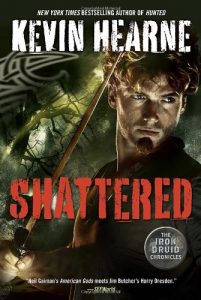
The Iron Druid Chronicles — Kevin Hearne (2011–2018)
Synopsis: Atticus O’Sullivan is the last living druid, running an occult bookshop in Arizona and trying to avoid being murdered by irritable gods. The series draws from a wide mythology pool: Celtic, Norse, Hindu, Native American, and more. Atticus’s Irish wolfhound, Oberon, provides running commentary that cuts through the seriousness.
Why it matters: This is mythology-first storytelling. There’s no central romance and no real attempt to market toward that niche. The appeal is in culture clash, divine politics, and the comedy of a two-thousand-year-old guy interacting with modern technology.
Readers who want mythology without the YA-romance packaging often pick up Hearne. The series also demonstrates that urban fantasy doesn’t need to be gloomy or noir; it can be playful, transnational, and irreverent.
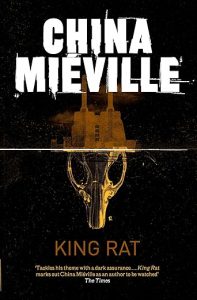
King Rat — China Miéville (1998)
Synopsis: After being wrongfully accused of murdering his father, Saul Garamond breaks out of jail with the help of a mysterious figure called King Rat. Saul learns that London’s hidden world is full of strange species tied to the city’s vermin, birds, and urban ecosystems. Jungle, drum & bass, and sound as weaponry become central to the plot as Saul is hunted by the Pied Piper—reinvented here as a violent, sonic predator.
Why it matters: Miéville sidesteps the romantasy template and veers into myth remix, horror, and urban subculture. The city isn’t just a backdrop; it’s part organism, part battleground.
Readers get folk motifs reframed through modern nightlife, class alienation, and underground music scenes. It scratches a very different itch than the usual UF suspects and is a reminder that “urban fantasy” can be political, abrasive, and structurally experimental.
Anyone who wants UF that feels less Marvel and more counterculture or left-field speculative fiction should look at King Rat.
Urban fantasy’s future likely depends on discoverability. Streaming-era tastes lean toward mystery, lore, and worldbuilding, which aligns more with the titles above than with romantasy.
A lot of newer work mixes genres: library adventures (The Invisible Library), supernatural detectives (Lockwood & Co.), comedic cosmic bureaucracy (Hogfather, which isn’t marketed as UF but overlaps). The broader point is simple: urban fantasy isn’t defined by vampires or love triangles. Those are just the loudest signals in the data.
Readers who’ve avoided the genre because of romance-heavy marketing might be missing out on what makes urban fantasy interesting in the first place: the idea that magic isn’t an escape from the modern world but part of it, hidden in alleyways, courtrooms, train tunnels, and bureaucracies. If you’re curious where to start, the five books above are sufficiently different from each other that one will probably click.
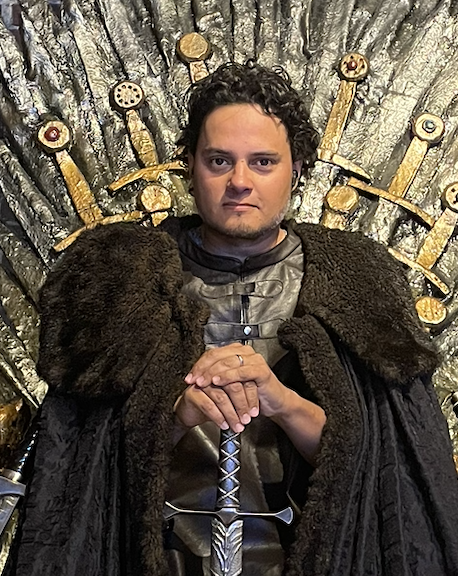
D.P. Martinez is a contemporary fantasy author specialising in urban fantasy and magical realism. He holds an M.A. in English Literature from the University of Greenwich, where he focused on Literary London. His research explored metaphorical representations of London in urban fantasy. He has written hundreds of articles and several books across both fiction and non-fiction.