
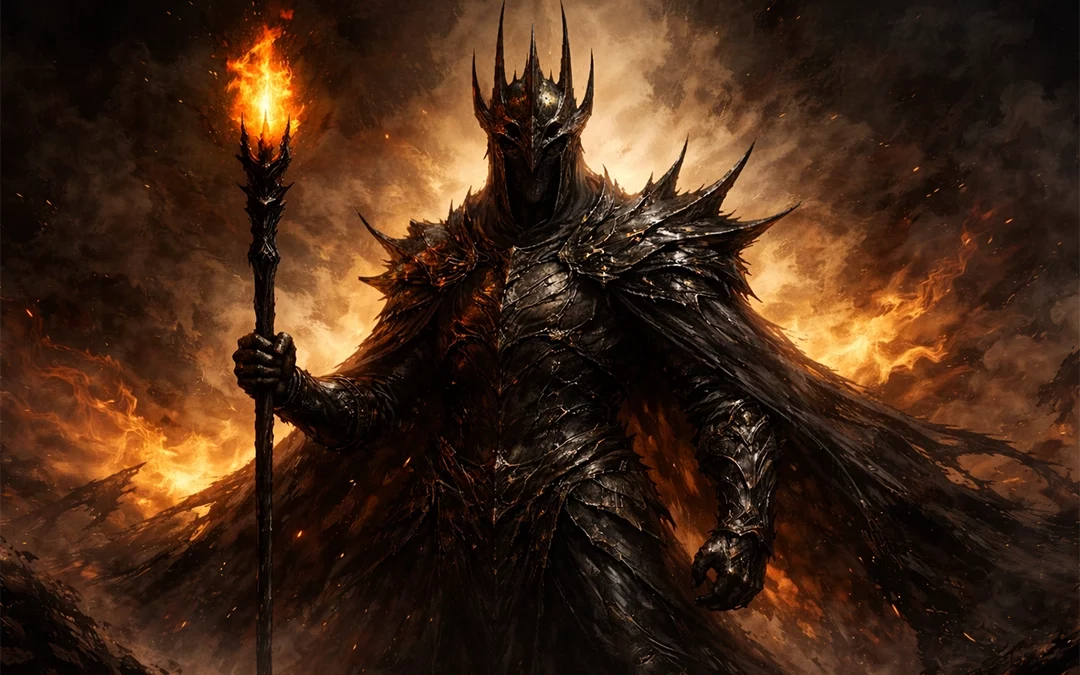
Fantasy villains are often discussed in terms of power levels, body counts, or how memorable their final confrontation is. That approach misses what actually makes certain antagonists last. The most influential fantasy villains don’t just oppose the hero. They determine how reality works inside the story.
The following five figures stand out not because they are the loudest or most shocking, but because they operate at a structural level. Each one shapes politics, morality, history, and even metaphysics within their fictional world. Remove them, and the entire narrative logic collapses.
Here’s the countdown.
YOU MAY ALSO BE INTERESTED IN: Beyond Vampires and Werewolves: Unusual Creatures in Urban Fantasy
5. The Dark One — The Wheel of Time by Robert Jordan
The Dark One functions less as a character and more as a metaphysical problem. His goal is not domination or destruction in the conventional sense, but alteration. Reality itself becomes the battlefield.
Jordan positions evil as something embedded in the pattern of existence. Free will, repetition, entropy, and recurrence all revolve around the Dark One’s attempt to break the Wheel. This gives the series a philosophical backbone rarely matched in epic fantasy. The antagonist forces the protagonists into questions about choice, inevitability, and moral responsibility, rather than simple heroism.
What makes the Dark One compelling is restraint. He does not need constant page time. His influence appears through corruption, madness, decay, and distortion. The conflict feels cosmic without becoming abstract, which is a difficult balance to maintain across a long series.
4. Randall Flagg — The Stand and The Dark Tower by Stephen King
Randall Flagg occupies a strange position in fantasy because he crosses genres, worlds, and narrative modes. He is neither purely supernatural nor entirely human. That ambiguity is the point.
Flagg’s power lies in social destabilisation. He exploits fear, resentment, and tribal instincts. Societies collapse not because he destroys them directly, but because he encourages people to dismantle themselves. Authority, belief, and violence all flow naturally from his presence.
King treats Flagg as a constant rather than a climax. He appears, disappears, changes names, and adapts. That mobility makes him feel more realistic than many high-fantasy villains. He resembles a recurring pattern in history rather than a single threat. The result is a villain who feels disturbingly plausible, even when operating in supernatural settings.
3. The White Witch (Jadis) — The Chronicles of Narnia by C.S. Lewis
Jadis rules Narnia through stasis. Eternal winter without Christmas is not just a striking image; it is a political condition. Time itself becomes frozen under her reign.
Her power blends seduction, fear, and legalism. The Witch understands contracts, rituals, and consequences. She uses enchantment selectively, preferring systems that lock others into obedience. Violence exists, but bureaucracy and inevitability do most of the work.
Lewis presents evil here as cold, controlled, and aesthetically appealing. Jadis is composed, articulate, and confident in her right to rule. That calm authority makes her more unsettling than a chaotic villain. She represents tyranny that feels orderly and justified, which is often the most durable kind.
2. Morgoth — The Silmarillion by J.R.R. Tolkien
Morgoth is not merely the first Dark Lord; he is the source of corruption itself. Tolkien frames evil as a creative failure. Morgoth cannot create independently, only twist what already exists.
This distinction matters. Orcs, dragons, corrupted landscapes, and broken beings all trace back to his interference. Evil becomes parasitic rather than generative. That idea runs through much of modern fantasy, whether acknowledged or not.
Morgoth’s significance lies in scale and consequence. Even after his defeat, the damage remains. The world does not reset. History carries scars. This approach rejects the idea of clean endings and positions evil as something that permanently alters the fabric of existence.
1. Sauron — The Lord of the Rings by J.R.R. Tolkien
Sauron refines Morgoth’s legacy. He operates through systems: armies, artefacts, surveillance, bureaucracy, and fear. Physical presence becomes unnecessary once power is properly distributed.
The One Ring embodies this logic. Control is outsourced, decentralised, and internalised by others. Sauron does not need to appear because his influence already permeates the world.
This makes him uniquely modern as a villain. Authority flows through structures rather than charisma. Obedience becomes habitual. Resistance requires sacrifice rather than strength. Tolkien anticipates how domination functions when it is embedded into tools, incentives, and institutions.
What These Villains Have in Common
None of these antagonists rely on constant confrontation. Their real power lies in shaping the conditions under which everyone else operates. Heroes respond to them not by overpowering them directly, but by rejecting the systems they impose.
That is why these villains persist across decades of readership. They are not obstacles to overcome, but environments to survive.
Fantasy often gets dismissed as escapism. These villains argue otherwise. They reflect enduring questions about authority, corruption, ideology, and control. Strip away the magic, and the structures remain recognisable.
D.P. Martinez is a contemporary fantasy author specialising in urban fantasy and magical realism. He holds an M.A. in English Literature from the University of Greenwich, where he focused on Literary London. His research explored metaphorical representations of London in urban fantasy. He has written hundreds of articles and several books across both fiction and non-fiction.