
Fantasy readers love magic, miracles, gods, prophecies, and impossible rescues. What they don’t love is feeling tricked.
That tension sits at the heart of one of the most controversial narrative devices in the genre: deus ex machina.
The fantasy trope isn’t new. It’s ancient, structural, and surprisingly revealing—not just about stories, but about what readers expect from fantasy in particular.
What “Deus Ex Machina” Actually Means
The phrase literally means “god from the machine.” In ancient Greek theatre, when a playwright had written themselves into a corner, a crane (mechane) would lower an actor playing a god onto the stage. The god would resolve the conflict, deliver judgment, or restore order. Curtain. Applause. Home for dinner.
Aristotle disliked this move intensely. In Poetics, he argued that resolutions should arise from the story itself, not from external interventions. That critique still holds.
In modern storytelling, deus ex machina refers to any sudden, unexpected force that resolves a central conflict without being sufficiently set up—or without requiring meaningful action or sacrifice from the characters.
Fantasy, perhaps more than any other genre, lives dangerously close to this edge.
Why Fantasy is Especially Vulnerable
Fantasy worlds already bend reality. Magic exists. Gods intervene. The impossible happens daily. That flexibility is the genre’s strength—but also its risk.
Because fantasy asks readers to accept so much, internal logic matters more, not less.
Readers subconsciously track:
- What magic can and can’t do
- Who has power, and at what cost
- Which rules are flexible, and which are sacred
When a resolution ignores those internal contracts, it doesn’t feel wondrous. It feels arbitrary.
And arbitrariness kills tension retroactively.
The Eagles Problem (and why it won’t die)
No discussion of deus ex machina escapes the shadow of The Lord of the Rings.
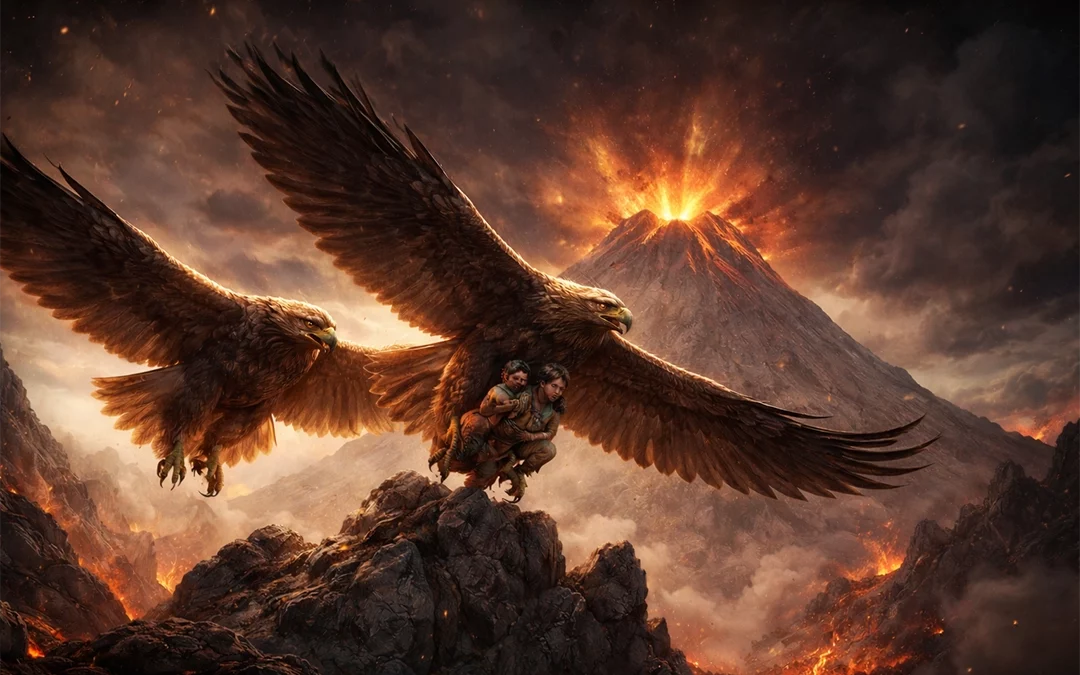
Why didn’t the Eagles just fly Frodo to Mordor? The question refuses to go away because both sides have a point.
The defence: The Eagles are sentient beings, not tools. They have their own limits, politics, and risks. Flying into Mordor would attract Sauron’s full attention. Their help is rare and conditional.
The criticism: The Eagles appear repeatedly at moments of absolute narrative desperation—rescues that arrive when all hope seems lost. Their timing, not their existence, is the problem.
What’s telling isn’t which side is “right,” but why the debate persists. The Eagles expose a core anxiety: If salvation can always arrive from outside the heroes’ choices, how real were the stakes?
Tolkien largely escapes the charge because the true resolution of the story—Frodo’s moral failure and Gollum’s intervention—comes at a terrible cost and follows the story’s ethical logic. Still, the unease lingers.
Other Examples of Deus Ex Machina
Some cases are less ambiguous.
In The Lion, the Witch and the Wardrobe, Aslan’s resurrection is justified through “deep magic from before the dawn of time.” The issue isn’t theological—it’s narrative. The rule explaining the miracle is introduced after the sacrifice. For readers approaching Narnia as allegory, this works. For readers reading it as fantasy adventure, it can feel like the ground shifts under their feet.
In Harry Potter and the Prisoner of Azkaban, the Time-Turner is clever, emotionally satisfying, and neatly executed. It also creates a problem so large that the series later destroys all Time-Turners off-screen. That quiet cleanup speaks volumes. Rowling solved one book beautifully—and nearly broke the series’ future stakes in the process.
In later seasons of Game of Thrones, sudden rescues, improbable survivals, and last-minute saves replaced the earlier seasons’ ruthless causality. The backlash wasn’t about dragons or magic. It was about narrative debt coming due.
When Deus Ex Machina Can Work
Not every divine intervention is a failure. Context matters.
Mythic and religious fantasy often embraces deus ex machina openly. In these stories, gods aren’t cheats—they’re the point. Human agency is limited by design. Fate, not choice, drives meaning.
Tragedy can absorb divine intervention if it comes too late or worsens the outcome. A god who intervenes and still fails to save what matters reinforces, rather than dissolves, the theme.
Satire and meta-fiction can deploy the trope knowingly, even mockingly, making the artificiality part of the experience.
The problem isn’t the presence of miracles. It’s the direction they move the story.
The Real Issue: Agency and Cost
Fantasy readers rarely articulate this explicitly, but their reactions are remarkably consistent. Readers tolerate almost anything if:
- Characters still make meaningful choices
- Those choices carry irreversible consequences
- Power comes with loss, limitation, or trade-offs
They resist when:
- Problems dissolve without sacrifice
- Victory arrives without decision
- Danger is revealed to have been cosmetic
A miracle that responds to character choice feels earned. A miracle that replaces character choice feels like authorial panic.
Surprise vs. inevitability
Great fantasy endings often feel surprising on first read—and inevitable on reflection. That’s the opposite of deus ex machina.
A useful test is this: If you removed the final solution and replaced it with “and then a miracle happened,” would the story collapse? If the answer is yes, the miracle is doing too much work.
Fantasy thrives when magic deepens causality rather than erasing it—when wonder sharpens stakes instead of blunting them.
Why this Trope Still Matters
Deus ex machina discussions persist because they aren’t really about plot mechanics. They’re about trust.
Fantasy readers invest emotionally, intellectually, and morally in imaginary worlds. They want to believe that actions matter inside those worlds—even if the worlds themselves are impossible.
Magic can bend reality. It shouldn’t bend responsibility. And that, more than anything, is why a pair of giant Eagles can still cause arguments decades later.
D.P. Martinez is a contemporary fantasy author specialising in urban fantasy and magical realism. He holds an M.A. in English Literature from the University of Greenwich, where he focused on Literary London. His research explored metaphorical representations of London in urban fantasy. He has written hundreds of articles and several books across both fiction and non-fiction.