
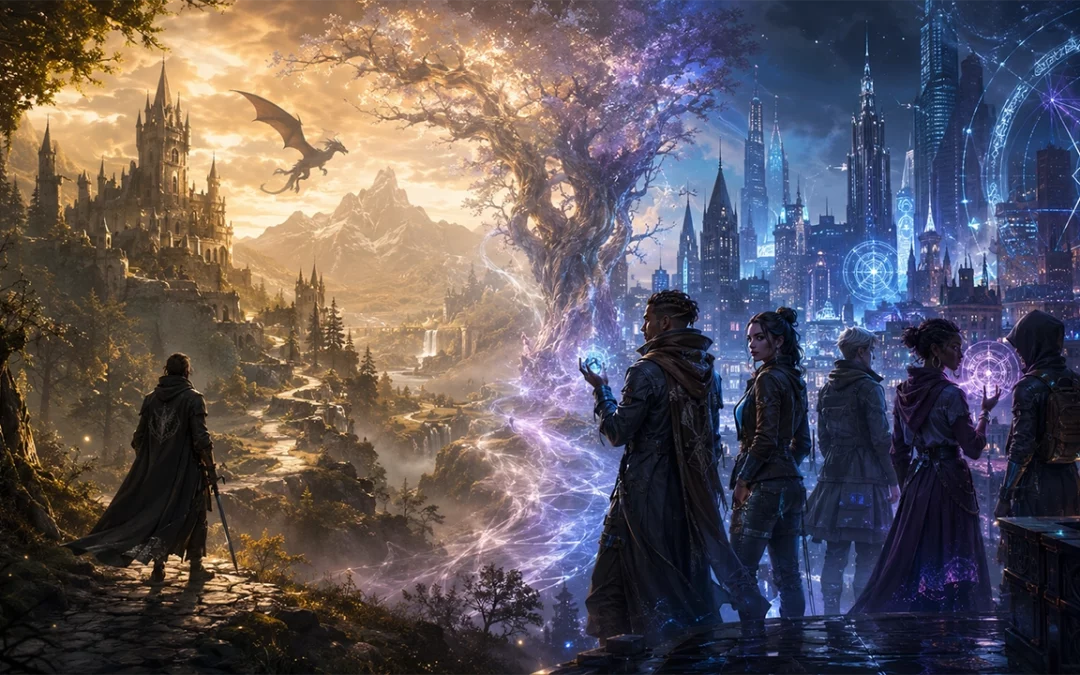
Spend five minutes on YouTube, Reddit, or fantasy TikTok and you will eventually run into some version of the same argument: modern fantasy has lost what made classic fantasy special.
Sometimes the complaint is about tone. Modern fantasy, some readers say, is too sarcastic, too cynical, too full of contemporary dialogue. Sometimes it is about magic systems, where every spell has rules, costs, limitations, and a diagram waiting to happen. Sometimes it is about politics, representation, grimdark violence, romance tropes, or the feeling that too many new fantasy books are built from marketable ingredients rather than genuine wonder.
Then comes the counterargument: classic fantasy was not perfect either. It often centred the same kinds of heroes, borrowed heavily from European medievalism, relied on hereditary kings and ancient bloodlines, and sometimes treated entire races or species as naturally good or evil. Modern fantasy, its defenders argue, did not ruin the genre. It opened the gates.
Both sides have a point.
The debate between classic and modern fantasy is interesting because it is not only about books. It is about what readers want from fantasy in the first place. Do we come to fantasy for myth, beauty, moral clarity, and enchantment? Do we come for complexity, danger, political imagination, and characters who feel psychologically real? Do we want to escape the modern world, or do we want fantasy to help us understand it?
The answer, of course, is yes. Many of us want all of that. That is why the argument refuses to die.
What Do We Mean by Classic Fantasy?
When people talk about classic fantasy, they usually mean books that shaped the genre before the current wave of grimdark, romantasy, progression fantasy, cozy fantasy, and highly systematised epic fantasy. The obvious names are J.R.R. Tolkien, C.S. Lewis, Ursula K. Le Guin, George MacDonald, Lord Dunsany, Mervyn Peake, Lloyd Alexander, Susan Cooper, Patricia McKillip, and others who helped build the imaginative vocabulary many fantasy readers still carry around.
Classic fantasy often feels older than itself. Even when it was written in the twentieth century, it seems to reach backwards toward myth, folklore, fairy tale, medieval romance, religious symbolism, and oral storytelling. It gives us enchanted forests, hidden kingdoms, ancient evils, sacred objects, mysterious names, songs, prophecies, and journeys into darkness.
The best classic fantasy has an atmosphere that modern fantasy sometimes struggles to reproduce. Middle-earth feels like it existed before Tolkien wrote it down. Earthsea feels like a world held together by language, balance, and silence. Narnia, for all its simplicity and obvious allegorical elements, still gives many readers that childhood feeling of stepping through a door into something impossible and meaningful.
Classic fantasy also tends to be more comfortable with moral seriousness. It believes that courage matters. Mercy matters. Temptation matters. Power changes the soul. A promise can carry spiritual weight. A small act of pity can alter the fate of the world.
That sincerity is part of the appeal. Classic fantasy often has very little interest in winking at the reader. It does not need to constantly prove that it knows fantasy is silly. It commits to enchantment.
The Strongest Critique of Modern Fantasy: It Can Feel Too Ordinary
One of the most common complaints about modern fantasy is that it has lost atmosphere. The world may be full of dragons, gods, assassins, witches, fae courts, magical schools, and ancient empires, but the characters sometimes sound like people texting in a group chat.
This is not always a problem. Modern voice can be funny, sharp, intimate, and emotionally accessible. A fantasy novel does not need to sound like a fake translation of an ancient manuscript. In fact, one of the worst habits in fantasy is the attempt to sound “old” by stuffing the prose with awkward archaisms.
Still, the complaint has force. If every character speaks in the same rhythm of contemporary banter, the spell can weaken. Fantasy depends on a kind of threshold. The reader needs to feel that they have crossed into a world with its own pressure, history, customs, fears, and beauty. When the language feels too casual or too familiar, that threshold becomes harder to believe.
Classic fantasy often understood that style is not decoration. Style is part of the worldbuilding. Tolkien’s prose, songs, genealogies, and invented languages are not just extra furniture. They create the sense of a deep past. Le Guin’s restraint in Earthsea gives the world its spiritual weight. Patricia McKillip’s lyrical prose can make a castle, riddle, or forest feel half-dreamed and half-remembered.
Modern fantasy can absolutely do this too. Writers like N.K. Jemisin, Susanna Clarke, Sofia Samatar, Marlon James, Tamsyn Muir, and R.F. Kuang have all shown that contemporary fantasy can be stylistically ambitious. The issue is not that modern fantasy sounds modern. The issue is that some modern fantasy sounds flat.
Readers who miss classic fantasy are often not asking for elves, songs, and medieval kings. They are asking for language that makes the impossible feel sacred, dangerous, strange, or beautiful again.
Magic Systems: Wonder or Engineering?
Another major complaint is that modern fantasy over-explains magic.
In much classic fantasy, magic is mysterious. Gandalf does not pause to deliver a lecture on the mathematical limitations of his abilities. The White Witch’s power is frightening because it feels ancient, cold, and symbolic. In Earthsea, magic has structure, but it is also bound to truth, identity, and balance. Knowing the true name of a thing is not a clever trick; it is a profound relationship with reality.
Modern fantasy, especially in the wake of Brandon Sanderson’s influence, often treats magic as a system. Magic has rules. It has costs. It has categories. It can be studied, optimised, weaponised, and used to solve plot problems in satisfying ways.
There is nothing wrong with that. Hard magic can be thrilling. It creates fair play between writer and reader. If we understand what magic can and cannot do, then magical solutions feel earned rather than convenient. A good hard magic system can make a fantasy novel feel like a heist, a puzzle, a science experiment, and a battle strategy all at once.
The danger is that magic can become too mechanical. When everything is explained, magic risks becoming technology with better branding. Wonder depends partly on distance. If the reader understands every lever behind the curtain, the curtain stops shimmering.
This does not mean soft magic is automatically better. Soft magic can become lazy when it allows the author to solve any problem through vague mystical power. Hard magic can be brilliant when it reveals character, society, economics, or moral cost. The real question is not whether magic should have rules. The question is what feeling the magic is meant to create.
If the story wants awe, dread, holiness, or fairy-tale mystery, too much explanation may damage it. If the story wants strategy, clever reversals, and problem-solving, rules may be exactly what it needs.
Fantasy has room for both Gandalf and allomancy. The problem begins when one mode becomes the expected default for every kind of story.
Has Modern Fantasy Become Too Cynical?
Classic fantasy is often associated with moral clarity. That does not mean it is simplistic. Tolkien’s work, for example, is deeply concerned with temptation, pity, corruption, weakness, and the limits of power. Frodo is not a triumphant warrior who defeats evil through strength. He is wounded, diminished, and saved partly through mercy he extended earlier.
Still, classic fantasy often believes in good and evil as real forces. It believes that some choices matter beyond politics. It believes that beauty can endure. It believes that darkness is terrible, but not ultimate.
Modern fantasy often distrusts that kind of moral architecture. Grimdark and post-grimdark fantasy gave us corrupt institutions, compromised heroes, brutal politics, failed prophecies, and worlds where survival often matters more than virtue. This was a necessary correction in many ways. Fantasy kingdoms should not get a free pass just because they have banners and ancient swords. Chosen ones can be dangerous. Empires have victims. Noble houses are often only noble because someone else paid the price.
The critique is that modern fantasy sometimes confuses bleakness with depth. If everyone is selfish, every institution is corrupt, every ideal is naive, and every victory curdles into failure, the story can become just as predictable as the simplest good-versus-evil quest.
Cynicism can become its own kind of naivety. It claims to see through everything, but sometimes it sees less than hope does.
That said, moral ambiguity is not the enemy of fantasy. Some of the best modern fantasy uses ambiguity to test the reader’s assumptions. George R.R. Martin’s A Song of Ice and Fire became influential not simply because it killed characters, but because it asked what honour means in a dishonourable system. Joe Abercrombie’s work is often brutal and funny at the same time, but beneath the blood and irony is a serious interest in self-deception, power, and whether people can change.
The best modern fantasy does not destroy moral meaning. It makes moral meaning harder won.
The Politics Question in Modern Fantasy
Many readers complain that modern fantasy is too political. They feel that some books are more interested in making arguments about identity, colonialism, gender, capitalism, climate change, or oppression than in telling a compelling story.
There are weak versions of political fantasy. Sometimes characters speak like essays. Sometimes a secondary world feels like a thinly disguised comment section. Sometimes the moral position of the book is so obvious from page ten that the rest of the story feels like a long confirmation.
But the idea that classic fantasy was apolitical is not convincing. Tolkien wrote in the shadow of war, industrialisation, modernity, and the destruction of rural landscapes. C.S. Lewis was openly theological. Le Guin explored gender, anarchism, Taoism, colonialism, ecology, and anthropology. Fantasy has always carried values. It has always imagined forms of power, community, authority, evil, gender, nature, and belonging.
What has changed is that modern fantasy is often more explicit about its concerns. It is more likely to ask who was excluded from the old myths. It is more likely to question monarchy, empire, prophecy, chosen bloodlines, and the assumption that one culture’s mythology should stand in for everyone’s.
That is a strength when it is done well. Fantasy should be able to interrogate power. It should be able to imagine worlds beyond inherited hierarchies. It should be able to ask why the farm boy becomes king, why the dark-skinned empire is described as exotic, why the “monstrous race” is naturally violent, or why women are present mainly as queens, witches, mothers, or rewards.
The weakness comes when politics are not transformed by imagination. A theme has to become world, plot, image, character, conflict, and consequence. If a novel simply imports modern discourse into a fantasy costume, readers can feel the machinery too clearly.
Good political fantasy does not lecture from outside the story. It makes the world itself argue.
Representation and the Expansion of Fantasy
For a long time, the default image of fantasy was heavily shaped by European settings, male heroes, hereditary power, pseudo-medieval aesthetics, and racialised species. There were always exceptions, and the history of fantasy is more varied than many people remember, but the mainstream image was narrow.
Modern fantasy has brought in more women protagonists, queer characters, disabled characters, neurodivergent characters, older protagonists, non-European mythologies, diasporic identities, anti-colonial perspectives, and stories rooted in cultures that classic fantasy often ignored or exoticised.
Some readers complain that this has made fantasy feel agenda-driven. That can happen when representation is handled lazily, as a surface feature rather than a lived reality inside the story. But the solution is not to return to the old defaults. The solution is better writing.
Representation is not a genre trend in the shallow sense. It changes what kinds of stories fantasy can tell. A fantasy novel based on West African cosmology, Indigenous futurity, Chinese history, Caribbean folklore, or Mexican myth does not merely swap the scenery. It can alter the structure of magic, family, time, death, community, and heroism.
Classic fantasy gave us a powerful inheritance. Modern fantasy is asking why that inheritance was treated as universal.
That question is healthy for the genre.
The Trope Problem
Modern fantasy is also more openly shaped by tropes. Readers now search for very specific things: enemies to lovers, found family, morally grey heroes, dark academia, cozy fantasy, fae bargains, magical schools, shadow daddies, chosen ones, reluctant necromancers, portal worlds, and books that feel like a particular aesthetic.
This can be fun. Readers have always loved patterns. The quest, the mentor, the hidden heir, the forbidden forest, the magical object, the underworld descent, the talking animal, the dark lord, the lost kingdom — classic fantasy was full of tropes too.
The difference is that modern readers and publishers often name the tropes upfront. The pitch can become almost more important than the story: “It is this trope plus that trope in this setting with this vibe.”
The danger is obvious. Books can start to feel assembled rather than discovered. Instead of a story that demands its own shape, we get a package of familiar pleasures. The result may be readable, marketable, and emotionally satisfying, but it can also feel strangely disposable.
Still, tropes are not the enemy. A trope is only a repeated pattern. It becomes a cliché when the writer does not put pressure on it. The chosen one can still work. The dark lord can still work. The magical school can still work. The portal can still work. The question is whether the story finds a new emotional, moral, or imaginative reason for using it.
Classic fantasy used ancient patterns. Modern fantasy uses labelled patterns. Both can become stale. Both can be renewed.
What Classic Fantasy Still Does Better
Classic fantasy still has lessons modern writers and readers should not dismiss.
First, it understands the power of mystery. It does not always explain the ancient thing in the forest, the song in the mountain, the door in the wall, or the full nature of evil. It trusts the reader to feel significance without turning every detail into lore.
Second, it often has a stronger relationship with beauty. Modern fantasy can be beautiful, but a lot of it is driven by pace, plot, voice, and concept. Classic fantasy is often willing to slow down for wonder, landscape, ritual, speech, and silence.
Third, classic fantasy is usually less embarrassed by sincerity. It can speak about courage, mercy, sacrifice, and goodness without needing to undercut itself with irony. That is not childish. In some ways, it is braver than cynicism.
Fourth, classic fantasy often treats fantasy as more than content. It treats it as a mode of perception. The world becomes strange again. Ordinary things recover significance. A road, a tree, a name, a meal, a sword, or a door can feel charged with meaning.
Modern fantasy could use more of that.
What Modern Fantasy Does Better
First, it is better at questioning inherited power. It does not automatically trust kings, prophecies, empires, bloodlines, or ancient orders. That suspicion has produced richer political fantasy and more complex worlds.
Second, it has expanded the genre’s imaginative sources. Fantasy no longer needs to look like a map of medieval Europe with altered spelling. It can draw from global mythologies, cities, diasporas, colonised histories, contemporary anxieties, and hybrid identities.
Third, it often gives characters more psychological depth. Trauma, grief, ambition, identity, family systems, social pressure, and institutional violence are explored with more explicit attention than in much older fantasy.
Fourth, it has diversified the emotional range of the genre. Fantasy can now be cozy, romantic, horrific, literary, satirical, political, mythic, domestic, epic, intimate, or weird. That variety is not a decline. It is abundance.
Modern fantasy’s greatest achievement may be that it has made the genre harder to define. That frustrates some readers, but it also keeps fantasy alive.
So, Has Modern Fantasy Lost the Magic?
Some modern fantasy is too quippy, too market-shaped, too mechanical, too cynical, or too eager to explain itself. Some books feel as if they were designed from a trend report. Some worlds have maps but no mystery. Some characters have trauma but no mythic depth. Some magic systems are clever but not magical.
But classic fantasy had its own failures. Some of it was narrow, hierarchical, derivative, morally simplistic, or blind to the assumptions it carried. Some of it mistook oldness for depth. Some of it treated entire peoples as symbols rather than persons.
The best path forward is not to choose one side. The future of fantasy depends on a better fusion.
Fantasy needs the wonder of the old tradition and the questions of the new one. It needs myth, but not nostalgia. It needs complexity, but not cynicism. It needs representation, but also deep characterisation. It needs politics, but transformed through story. It needs magic systems when rules create drama, and mystery when explanation would kill the spell.
The best fantasy makes the world feel larger than it did before you opened the book. Classic fantasy did that through myth, enchantment, and moral imagination. Modern fantasy does it through expansion, interrogation, and reinvention.
Readers do not need to pick a team. You can love Tolkien and Jemisin. You can love Le Guin and Abercrombie. You can want dragons and political complexity, beauty and brutality, fairy-tale mystery and social critique.
The real question is not whether classic fantasy is better than modern fantasy.
The better question is this: when you open a fantasy novel, what kind of magic are you hoping to find?
D.P. Martinez is a contemporary fantasy author specialising in urban fantasy and magical realism. He holds an M.A. in English Literature from the University of Greenwich, where he focused on Literary London. His research explored metaphorical representations of London in urban fantasy. He has written hundreds of articles and several books across both fiction and non-fiction.