
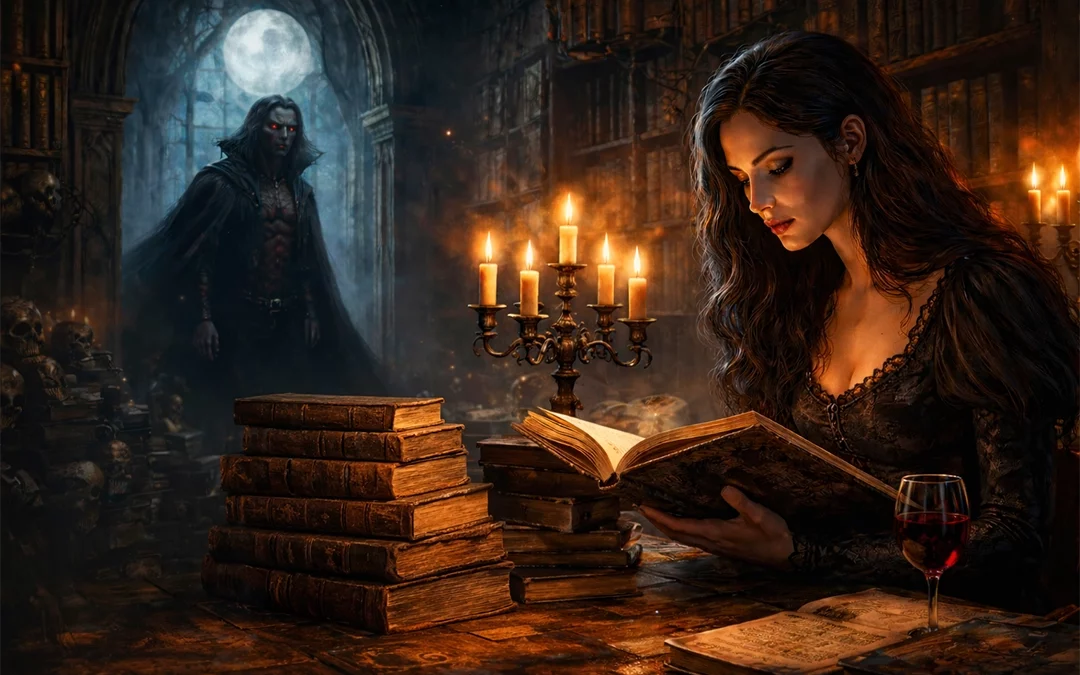
If you ask most readers for “the best vampire books”, you’ll usually get a list driven by popularity, adaptations, or what happens to be trending on BookTok.
That’s fine. But it dodges a much more interesting question:
Which vampire novels actually changed the urban fantasy genre, pushed literary boundaries, or still attract serious critical attention decades later?
Below is a reader-first guide to vampire fiction that critics, scholars and serious genre commentators keep returning to—not because they sold well, but because they did something new with the vampire myth.
As someone who reads urban fantasy and literary fantasy side-by-side (and who is allergic to formulaic romantasy), this list leans deliberately toward books that treat the vampire as a cultural, ethical or psychological problem—not just a love interest with fangs.
YOU MAY ALSO LIKE: Beyond Vampires and Werewolves: Unusual Creatures in Urban Fantasy
The Books That Defined the Vampire in Literature
You cannot seriously talk about literary vampire fiction without starting here.
Carmilla by Sheridan Le Fanu
Carmilla predates Dracula and quietly shapes almost everything that follows. Its real importance is not the plot, but the tone: intimacy, ambiguity, and the unsettling collapse between desire and danger. Modern critics often point out how unusually forward its treatment of attraction and power feels for a nineteenth-century Gothic novella.
Then comes the unavoidable pillar:
Dracula by Bram Stoker
What still holds up here is not simply the villain, but the form. The fragmented documents, letters and reports create a sense that modern bureaucracy and rational systems are struggling to contain something ancient and irrational. Contemporary literary critics frequently read Dracula through lenses of empire, sexuality, and late-Victorian anxiety rather than pure horror.
Jump almost a century forward and you get one of the most critically respected modern reinventions of the myth:
Salem’s Lot by Stephen King
What makes this book endure academically is its social focus. The vampire infection becomes a slow moral collapse of an entire town. Many critics place it alongside Dracula as one of the rare works that successfully relocate the vampire into a modern, recognisable social structure without weakening the horror.
The Psychological and Literary Turn
The late twentieth and early twenty-first centuries produced a decisive shift. Vampires stop being monsters outside society and start becoming narrators inside it.
The most influential example remains:
Interview with the Vampire by Anne Rice
Critics often credit Rice with transforming the genre’s emotional register. Immortality becomes a philosophical burden rather than a power fantasy. Guilt, memory and moral paralysis sit at the centre of the story. You can draw a straight line from Rice to almost every introspective or morally conflicted vampire that followed—whether literary or commercial.
A very different but equally respected approach appears in:
The Historian by Elizabeth Kostova
This novel treats the Dracula myth as an academic mystery. Archives, libraries and scholarly travel replace castles and coffins. Critics regularly highlight how the book turns historical research itself into a narrative engine, asking whether scholarship can safely excavate violent pasts without reactivating them.
From Scandinavia comes one of the most widely praised contemporary vampire novels:
Let the Right One In by John Ajvide Lindqvist
The book’s reputation rests on its emotional discomfort. Childhood loneliness, cruelty, and moral dependency shape the vampire relationship. Literary reviewers consistently note how it resists romanticising either innocence or monstrosity. The result feels closer to social realism with horror elements than genre spectacle.
Vampires as Politics, Identity and History
Some of the most critically significant vampire novels are not primarily interested in blood at all. They use the myth as a vehicle for social and ethical inquiry.
Fledgling by Octavia E. Butler
Fledgling remains one of the boldest experiments in the genre.
The novel combines vampire mythology with questions of race, consent, community and biological difference. Butler’s standing within academic speculative-fiction studies means this book is discussed far more often in university contexts than in genre marketing lists.
A quieter but deeply influential work is:
The Gilda Stories by Jewelle Gomez
Structured across two centuries, it reframes vampirism as a model of chosen family, ethical feeding and social responsibility. Critics often emphasise how the novel rewrites the vampire away from predation toward survival within marginalised communities.
More recently, Gothic reinvention has taken a sharply literary turn with:
A Dowry of Blood by S. T. Gibson
This epistolary retelling from the perspective of one of Dracula’s companions has drawn strong critical attention for its voice, emotional precision and interrogation of abusive power structures. It speaks directly to contemporary literary conversations about trauma and coercive relationships.
Dark Fantasy’s Contribution to Modern Vampire Literature
While not usually categorised as “literary fiction”, recent epic fantasy has also produced vampire narratives that attract serious critical engagement.
Empire of the Vampire by Jay Kristoff
Empire of the Vampire blends confessional narrative, religious symbolism and post-apocalyptic world-building.
Reviewers frequently highlight its structural ambition and its refusal to sanitise violence or institutional collapse. It demonstrates how modern fantasy is increasingly absorbing literary techniques traditionally associated with historical or confessional fiction.
What Makes These Books “Top” from a Critical Ooint of View?
A skeptical reader might ask whether critical prestige really matters for a genre built on myth and spectacle. It does, because these novels show how flexible the vampire actually is.
Across these works, three patterns repeat:
- the vampire becomes a tool for examining power, not just a predator;
- immortality becomes a problem of memory and responsibility, not glamour;
- and the monster increasingly reflects social systems rather than individual evil.
For readers already interested in how fantasy and urban fantasy interrogate cities, these vampire novels belong to the same evolving literary conversation.
The future of vampire fiction, if it stays interesting, will probably move further away from romance and closer to social and psychological inquiry.
The genre does not need shinier immortals. It needs sharper questions.
D.P. Martinez is a contemporary fantasy author specialising in urban fantasy and magical realism. He holds an M.A. in English Literature from the University of Greenwich, where he focused on Literary London. His research explored metaphorical representations of London in urban fantasy. He has written hundreds of articles and several books across both fiction and non-fiction.