
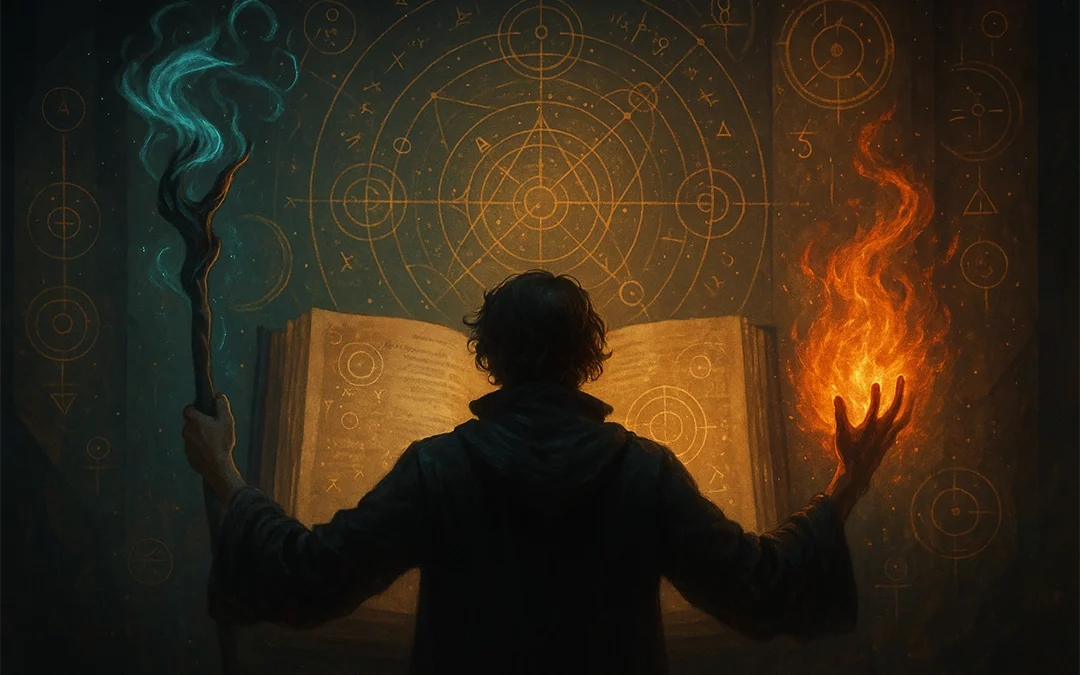
Magic systems are one of the main reasons fantasy feels, well… fantastic. They shape the rules of the world, reveal how power works, and often become the thing readers remember most once they finish a book. But not all magic works the same way, and some systems have become so influential that contemporary fantasy almost can’t escape their shadow.
If you’re exploring the genre, this guide walks you through the most popular magic systems in fantasy fiction, what makes them tick, and why they keep showing up on bestseller lists.
YOU MAY ALSO LIKE: The 9 Elements of an Unforgettable Magic System in Fantasy Fiction
Hard Magic Systems: When Power Has Rules
Hard magic works like a science. Readers know what the magic can and can’t do, which makes the world feel logical even when it’s full of sorcery.
Brandon Sanderson’s Cosmere
- Featured in Mistborn and The Stormlight Archive
- Metal-based powers, Investiture, Shards, clear mechanics
- Designed with “Sanderson’s Laws” in mind
Readers love the predictability. Critics sometimes argue it gets too technical. Either way, this is the blueprint most modern writers imitate.
Patrick Rothfuss’s Sympathy
- Seen in The Kingkiller Chronicle
- A physics-driven system that treats magic like force and energy
- Balanced with the mystical “Naming” magic
It’s grounded enough to feel real, but poetic enough to keep you guessing.
Soft Magic Systems: Mystery Over Mechanics
Soft magic doesn’t explain itself. It’s mythic, ancient, and more concerned with atmosphere than rules.
- Tolkien’s Middle-earth: Power is tied to history, language, and morality. Gandalf doesn’t have “spell slots”; his magic functions more like a force of nature.
- C.S. Lewis’s Deep Magic: Symbolic and allegorical. It’s less about using magic and more about acknowledging ancient universal laws.
These systems shaped the DNA of epic fantasy, even though they avoid detailed explanations.
Magic Rooted in Culture, Myth, or Ritual
Some authors build magic around folklore, belief systems, or occult traditions.
- Neil Gaiman: Neverwhere, American Gods, The Sandman
- Magic works because people believe in it. It grows, fades, or mutates depending on cultural attention.
- Susanna Clarke: Jonathan Strange & Mr Norrell
- Human magic is rational. Faerie magic is wild, unpredictable, and unsettling.
This approach mixes storytelling with anthropology, giving magic a cultural personality.
Magic in the Blood: Genetic or Ancestral Power
Magic passed through birthlines remains wildly popular and controversial.
- J.K. Rowling’s Wizarding World: Heritage, wands, spells, and magical laws form a hybrid system: partly rule-based, partly whimsical.
- N.K. Jemisin’s Orogeny
- The Broken Earth Trilogy: Magic fuels seismic control, tied to oppression, identity, and survival. It’s one of the genre’s smartest metaphors for systemic power.
Elemental & Energy-Based Magic
Fire, water, air, earth—simple, intuitive, globally recognisable.
- Avatar: The Last Airbender: Each bending art uses martial-arts logic. It’s visual, elegant, and surprisingly philosophical.
- The Wheel of Time: Magic is woven from elemental threads, with its own dangers and cultural divisions.
Elemental magic stays popular because readers grasp it instantly.
Magic With a Cost: Deals, Exchanges, and Sacrifices
The idea that “power always comes with a price” resonates with modern readers.
- Fullmetal Alchemist: Magic follows Equivalent Exchange: you must give something to get something.
- The Witcher: Chaos-fuelled power requires intense training, sacrifice, and physical tolls.
These systems feel honest—almost moral—because they mirror real-world choices.
Language-Based Magic: Power Through Words
One of the oldest traditions in fantasy.
- Ursula K. Le Guin’s Earthsea: True names shape reality. Language becomes metaphysics.
- China Miéville’s Bas-Lag: Strange, political, and often grotesque. Magic behaves like a biological or industrial process.
This kind of magic sparks worldbuilding that feels literary and philosophical.
Artefact-Based Magic: Relics, Ruins, and Old Civilisations
Readers adore worlds where magic is locked inside objects or places.
- Terry Pratchett’s Discworld: Objects gather “narrative charge,” creating magic through accumulated stories.
- The Stormlight Archive: Shardblades, spren bonds, fabrials—magic as technology.
Perfect for fans who enjoy archaeology mixed with sorcery.
Multiverse & Dimensional Magic
Fantasy is slowly drifting toward sci-fi territory, exploring alternate timelines and layered realities.
- Stephen King’s Dark Tower: Magic works across fractured worlds connected by beams and portals.
- Shadowhunters / Magisterium: Runes, dimensions, angelic power, and cross-world borders.
Expect to see even more of this as multiverse storytelling grows.
Why Magic Systems Matter So Much
Readers aren’t just drawn to spells and supernatural abilities. They’re drawn to what the magic represents:
- How societies distribute power
- Who gets access to knowledge
- What the world worships or fears
- How characters grow, struggle, or break
- Every magic system is basically a worldview wearing a cloak.
From rigid, rule-heavy magic to mysterious ancient forces, fantasy fiction offers a spectrum of systems that shape how stories feel and function. New authors continue to push boundaries—blending science, culture, mythology, and metaphysics—because the genre thrives when it questions how power works.
D.P. Martinez is a contemporary fantasy author specialising in urban fantasy and magical realism. He holds an M.A. in English Literature from the University of Greenwich, where he focused on Literary London. His research explored metaphorical representations of London in urban fantasy. He has written hundreds of articles and several books across both fiction and non-fiction.